“Shrinkage” of a chocolate bar – Misleading under Unfair Competition Law?

In its judgment of 13 May 2026, the Regional Court of Bremen (File No. 12 O 118/25) handed down a widely noted ruling on so-called ‘shrinkflation’. The central issue is whether reducing the contents of a chocolate bar whilst leaving the packaging virtually unchanged constitutes anti-competitive misleading of consumers. The court affirmed this in the specific case. The ruling makes it clear that when assessing packaging designs, one must not rely solely on formal compliance with food law labelling requirements. The overall impression from the perspective of the targeted consumers remains decisive.
What was the case about?
The Hamburg Consumer Advice Centre (“Verbraucherzentrale”) had taken legal action against the manufacturer of Milka chocolate. The background was the reduction in content from 100 g to just 90 g, whilst the packaging size remained almost identical, and the packaging design remained unchanged. However, the chocolate bar indicated the lower quantity of the product (90 g) in the usual places on the product – i.e. where the 100 g had previously been stated as depictions of the product in the judgement show:
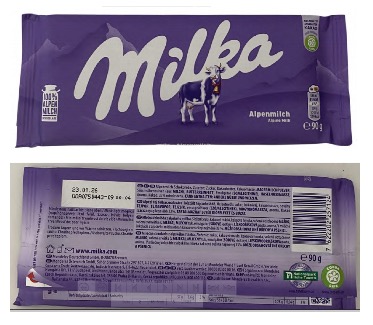
The consumer organisation bringing the action alleged that the manufacturer had misled consumers about the actual contents by using packaging that was virtually unchanged in appearance. The customer would not notice the change in the contents of the product because the design remained otherwise unchanged. The same applied to the altered unit price.
The decision of the Regional Court of Bremen
The Regional Court of Bremen upheld the claim. In the Chamber’s view, the ‘downsizing’ constitutes misleading conduct relevant under German Unfair Competition Law within the meaning of the Unfair Competition Act (UWG). The court clarified that packaging can be misleading even if the legally required indication of the net quantity is formally correct. The decisive factor is the overall impression from the perspective of the average consumer. The judges based their reasoning on the fact that consumers develop certain expectations regarding the contents and the packaging ratio when it comes to brand products that have been familiar for many years. If the net quantity is then reduced without the external design making this sufficiently clear, a misconception about the actual product quantity may arise.
In the judges’ view, mere compliance with formal labelling requirements is not sufficient if the overall impression created by the packaging is likely to give rise to misconceptions. In this context, the court referred to an impermissible case of ‘relative deceptive packaging’. Unlike in the case of classic deceptive packaging, where the packaging is disproportionately large in relation to the product, the packaging in the present case is not objectionable when viewed in isolation. Rather, the misleading nature arises from a comparison with the product previously introduced to consumers. If the manufacturer retains the old presentation/packaging size, the differing contents must be made clearer, at least for a transitional period. In this specific case, the Regional Court of Bremen took the view this would apply for at least four months.
A different scenario: Oversized packaging
A scenario similar, yet differing from the present case, is ‘absolute deceptive packaging’. This term is used when there is a significant disparity between the packaging and its contents. Typically, the packaging contains substantial amounts of air or empty space that are not necessary for technical reasons.
An example is when:
- the packaging appears significantly larger than the contents would justify,
- there are substantial empty spaces,
- consumers may reasonably expect a larger quantity of product due to the size of the packaging.
However, not all empty spaces are prohibited. Technically necessary empty spaces to protect the product, for production or to ensure transportability are permissible. The decisive factor is whether the empty space is functionally necessary or is merely used to promote sales. Oversized packaging may also be permissible if the reduced quantity is clearly indicated in the product presentation.
Implications for businesses and manufacturers
The recent decision by the Regional Court of Bremen on relative deceptive packaging is, admittedly, a case-by-case ruling and, as yet, only a first-instance judgement that is not yet final. In principle, however, the decision has the potential to have practical relevance beyond the specific case. The judgement confirms:
- A formally correct indication of quantity on a product that appears unchanged on the outside is not necessarily sufficient to ensure compliance with competition law. What matters is the overall impression on the consumer.
- Well-known branded products may be subject to heightened transparency requirements in this regard, and changes to the net quantity may need to be communicated more clearly in such cases.
- In such cases, it may be sufficient to indicate the changed quantity for a transitional period.
Legal classification
The legal basis for the decision is, in particular, the provisions of the Unfair Competition Act (UWG). The Regional Court of Bremen based its decision primarily on the provisions of Sections 3a, 5 and 5a of the UWG. According to these provisions, it is unfair to contravene a prohibition under Unfair Competition Law or to induce consumers, through misleading commercial practices, to make a purchasing decision that they might not otherwise have made. In the field of food law, the European Food Information Regulation (LMIV) is added as a supplementary prohibition under the UWG. This requires that information about foodstuffs must not be misleading.
Conclusion: The decision of the Regional Court of Bremen adds a further facet to case law concerning the competition law control of packaging designs. The judgment shows that courts focus on consumer perception and not solely on formal labelling requirements. Whilst ‘absolute deceptive packaging’ primarily concerns an objective mismatch between packaging and contents, ‘relative deceptive packaging’ relates to the exploitation of consumer habits through reductions in quantity that are difficult to detect visually. Without clarifying information, manufacturers and retailers therefore face the risk of competition law complaints in such cases.